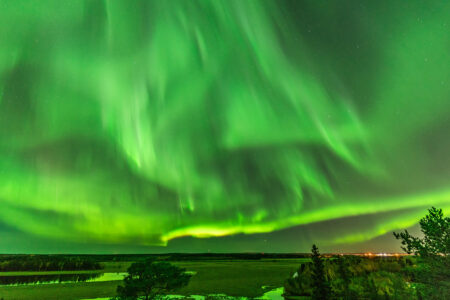
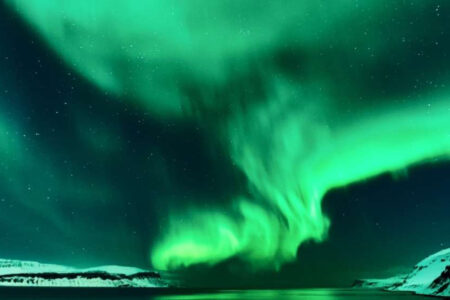
The northern lights are one of nature’s most spectacular displays — and one of the most unpredictable. They can shimmer into view without warning, glow softly for hours or vanish just as quickly as they appeared.
That sense of mystery is part of the magic. But when you’re travelling to the Arctic to see the aurora borealis, you want to maximise your chances. To do that, you need to use aurora forecast tools.
In this guide, we explain how aurora forecasts work and recommend our favourite northern lights forecast websites for trips to Finland, Norway, Sweden and Iceland.
Predicting the northern lights: how do they do it?
The northern lights are caused by solar activity.
Charged particles travel from the sun, on the solar wind, and collide with Earth’s magnetic field. This collision causes an explosion of light and colour.
The flow of solar particles isn’t constant. It varies from day to day and hour to hour. So scientists look to the sun when making their aurora forecasts.
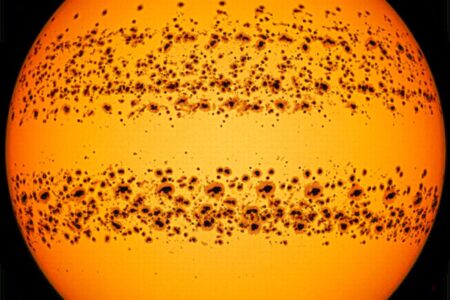
Sunspots (visible spots on the surface of the sun) often indicate an increase in aurora activity. Scientists also monitor solar flares and coronal mass ejections that are directed towards Earth.
There’s a delay in particles being released and reaching us here on Earth. So scientists can look at what’s happening on the surface of the sun to predict the behaviour of the northern lights over the coming days and weeks.
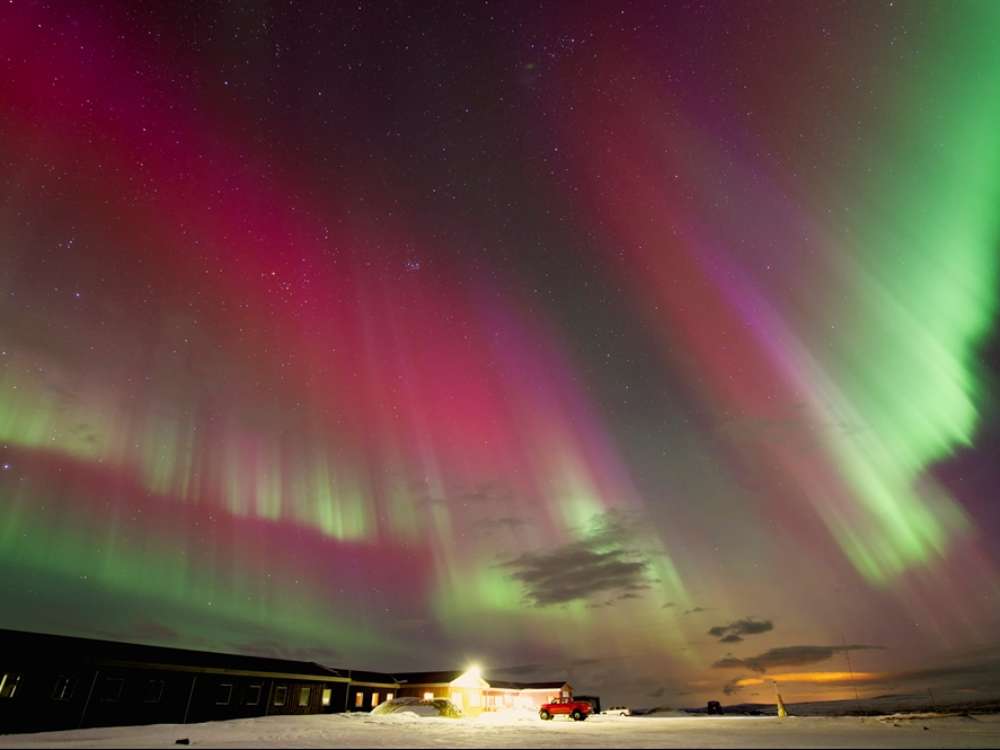
Making sense of a northern lights forecast
When you look at a northern lights forecast, you see predictions represented using a KP index number. But what does this actually mean?
The KP index is a scale from 0 to 9 that measures geomagnetic activity. The higher the number, the brighter, more intense and more colourful a northern lights display is likely to be — and the further south the aurora will be visible.
Here’s a quick rundown of what the KP index means when you’re on location in the Arctic:
- KP 0-1: Relatively weak aurora. Displays may appear faint or slow-moving
- KP 2-3: A very typical and promising level for Arctic destinations. At this level, aurora sightings are common on clear nights.
- KP 4-5: Strong aurora activity. You can expect bright colours, faster movement and more dramatic patterns.
- KP 6+: Intense geomagnetic activity. This indicates a moderate to extreme geomagnetic storm. It’s relatively uncommon, but if you’re in the Arctic during a storm, you’ll see exceptionally bright and dynamic displays.
When you’re in the Arctic Circle, even a low KP forecast can deliver a magical aurora experience. But by watching out for those higher numbers, and heading to the right locations at the right time, you maximise your chances of seeing the aurora borealis at its best.
Want to dive even further into the data? You can also use a northern lights forecast to look at:
- The strength of the Interplanetary Magnetic Field (Bt). Higher numbers indicate stronger displays.
- The polarity of the Interplanetary Magnetic Field (Bz). A negative value indicates a southward direction, which is good for aurora sightings.
- Solar wind speed. Higher speeds increase the likelihood of geomagnetic storms.
Northern lights forecasting tools for Iceland, Norway, Sweden and Finland
There are a number of research sites around the world that keep track of solar and aurora activity. Here are the three sites we recommend for aurora forecasts in Europe.
21-day northern lights forecast: University of Alaska
The University of Alaska in Fairbanks provides one of the most widely used aurora forecasts in the world. It provides a 21-day northern lights forecast, which you can view by region. This is excellent for long-range planning.
That said, these forecasts don’t take solar flares into account. So, as you get closer to the date of a northern lights viewing opportunity, we recommend using this tool in conjunction with SpaceWeatherLive.
3-day northern lights forecast: SpaceWeatherLive
Solar flares take around three days to get from the surface of the sun to Earth and they can have a big impact on the intensity of a northern lights display.
The SpaceWeatherLive website has detailed 3-day aurora forecasts and very good short-term indicators. So, if you’re in the Arctic or travelling within the next couple of days, this is a great website to reference.
Right now: Aurora borealis forecast app
In the Arctic right now? Then download My Aurora Forecast, available on both Apple and Android.
As well as aurora forecasts, this app provides a handy aurora alert. When the northern lights are visible in your chosen location — whether that’s Tromsø, Rovaniemi, Abisko or Reykjavik — you’ll receive a notification.
You can then head outside to view the northern lights as soon as they appear.
What role does the weather play?
Solar activity means little if the aurora is obscured by clouds. That’s why weather forecasts are just as important as aurora forecasts when you’re chasing the northern lights.
You need to consider solar activity and conditions here on Earth to have the best chance of seeing a bright and colourful aurora display.
Best weather forecasts for Iceland and the Nordics
There are lots of forecasting websites out there. But here are the ones we’ve found to be most reliable:
- Weather forecast for Iceland. In Iceland, the local met office provides very detailed weather information: Icelandic Met Office.
- Weather forecast for Norway, Sweden and Finland. For Norway, Sweden and Finland, we recommend this Norwegian weather platform, which provides in-depth forecasts. You can click the map view, then zoom in to see up-to-date weather information for your location.
When viewing the weather forecast, look for clear skies (with either a sun or a moon visible).
The best chance of seeing the northern lights? Forecast tools plus an expert aurora guide
If you’re planning a northern lights holiday, forecasting tools come in very handy. But nothing can replace local knowledge.
When you embark on aurora excursions with an experienced northern lights guide, they track the forecasts for you.
With years of experience, guides are skilled at hunting the northern lights — at finding a pocket of clear sky or predicting aurora activity over the course of an evening. They also know the most scenic locations for your northern lights photographs.
Their knowledge and instinct can mean the difference between missing the aurora and witnessing an unforgettable display.
Predicting a northern lights escape?
If a trip to see the northern lights is on your wish list this year, the Aurora Nights team is here to help.
We create tailor-made northern lights holidays to Iceland, Norway, Sweden and Finland — trips that combine hand-picked accommodation, unique itineraries and expert-led aurora excursions.
Want some inspiration? Explore our collection of northern lights tours and start imagining what your dream Arctic adventure will look like.
Browse our northern lights tours
Aurora forecast FAQs
How often is the aurora visible?
There’s always aurora activity somewhere on Earth. But you can’t always see it. Visibility depends on location, darkness, clear skies and the strength of solar activity. The aurora is most often visible in the Arctic.
Where is the best place to see the northern lights?
The best places to see the northern lights lie near or within the Arctic Circle. In Europe, that means Iceland and northern regions of Norway, Sweden and Finland.
Once you’re in the Arctic, you have the best chance of seeing the aurora borealis when you’re out in the countryside, away from the bright lights of towns and cities.
What is the best time of year to see the northern lights?
The aurora season runs from September to early April. During this time, nights in the Arctic are long and dark enough for the northern lights to be visible.
How do scientists predict the northern lights?
When predicting the northern lights, scientists use special solar telescopes, spacecraft and satellites. They gather data on solar activity, the solar wind and the Interplanetary Magnetic Field. They then use this data to predict how big and bright the northern lights are likely to be.
How accurate is the northern lights forecast?
The northern lights forecast is generally less accurate than the weather forecast. Accuracy improves the closer you are to the predicted date. Forecasts within 24 to 72 hours are usually fairly reliable.